Infinity's Kitchen № 11
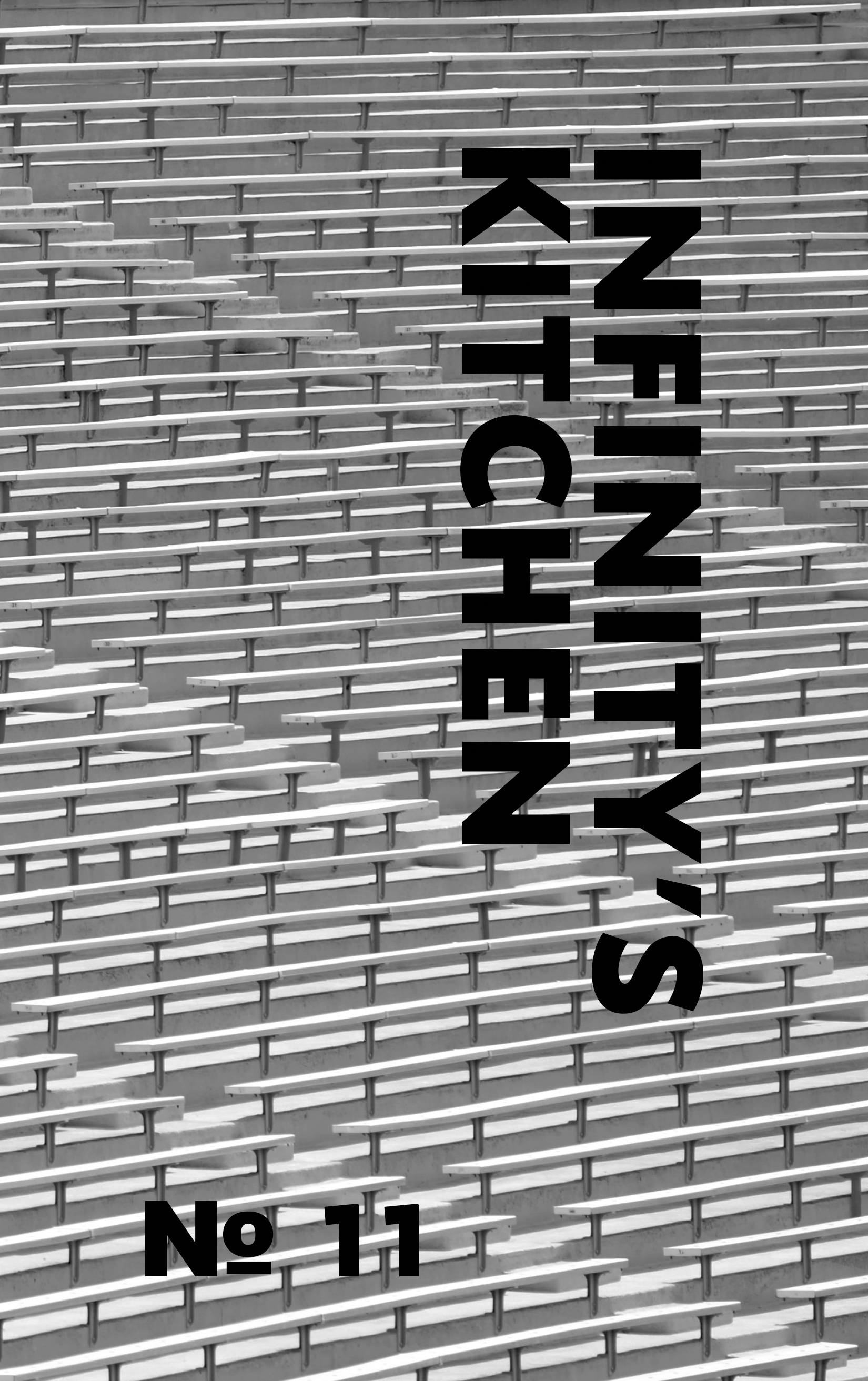
An exploration of very short performances. For fiction writers, very short forms are called "microfiction", or "nano-fiction." For many of the works collected here, online, and in our Late Show reading series, the performance is also microscopic. The possibilities seem endless, but brief.
| Online Features | |
|---|---|
| The Death and Life of Desmond Wolfe | Brett Williams and Desmond Wolfe |
| The Bench | Morgan Lee McDonald |
| When You Say You're a Swimmer | Chris Shimojima |
| Migration (Belarus) | John Ketchum |
| Late | Chong Yuen Ping |
| Last Supper Performance | Jennifer Hartley |
| Black Hole | Phil Sansom and Olly Williams |
Infinity's Kitchen № 10
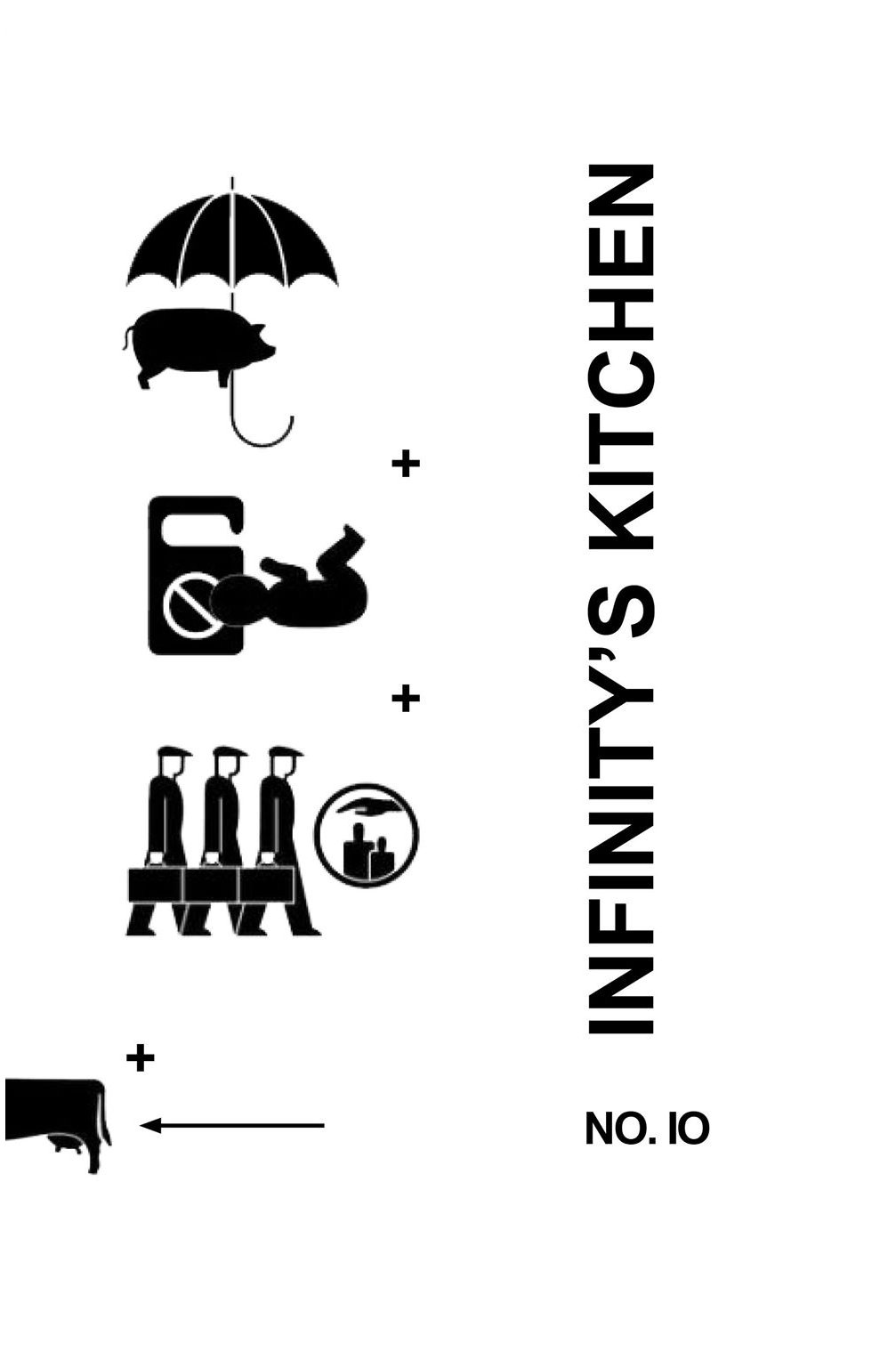
The tenth issue of Infinity's Kitchen was published on the publication's tenth anniversary, so although the publication isn't exactly annual, it was the tenth of its kind on the tenth year of those kinds.
| Online Features | |
|---|---|
| U$AAR | s4ra |
| Roadrage Atbash | Volodymyr Bilyk |
| One Sixteen Thirty-Eight | Alex Checkovich |
| from the series, A Lather of Letters | Nico Vassilakis |
Infinity's Kitchen № 09
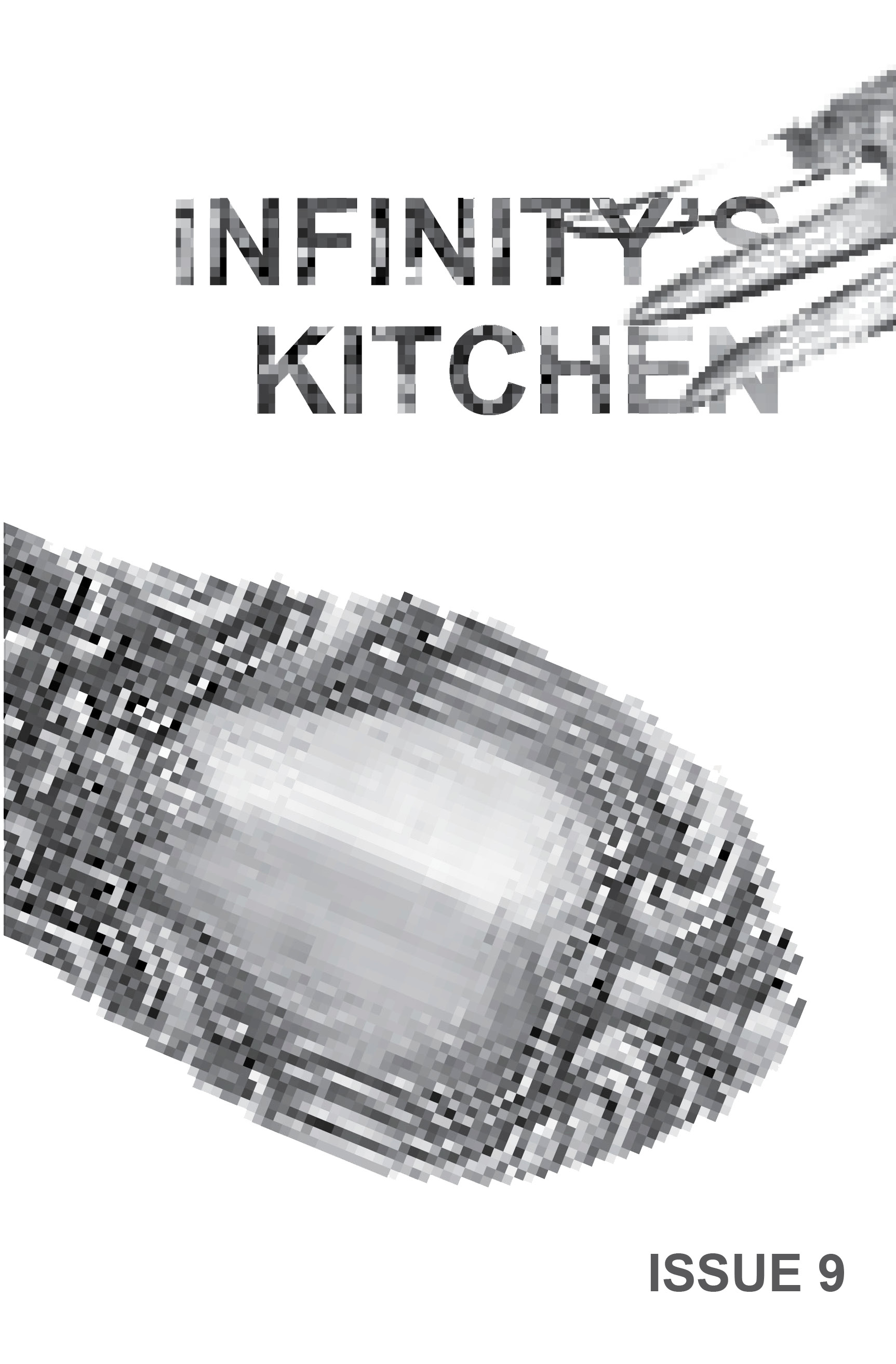
The ninth issue of Infinity's Kitchen was designed in an actual kitchen. Much of its inspiration came from cookbooks, and its contributors were encouraged to consider the "recipe" of their work, the ingredients, the process required to make the good stuff.
| Online Features | |
|---|---|
| Roasted New Potatoes and Arugula Salad | Jenny Wong |
| Dal Masoor | Jenny Wong |
| Kid Art Soldiers Take to the Rubbled Streets | Gregg Williard |
| Dreamers | Jonathan James |
| French Toast | Sid Church |
| Found-Word Collages | J.I. Kleinberg |
| Phantom Agents | Will Luers |
| Suppertime | Carl 'Papa' Palmer |
| Adrian Piper | John J Trause |
| txt | Ana Jovanovska |
| Sketch of an Angry Man | Holly Day |
| Is This The Recipe You're Using? | Juleigh Howard-Hobson |
| Deictic Dialectics | |
| Becoming Clyde | Matthew Laffrade |
| Able Was I Ere I Saw Elba. | Michael Demers |
Infinity's Kitchen № 08
The eighth issue of Ininfity's Kitchen, the "awkward geohyrophilia edition" is a bridge of sorts. Some of the contributors to the print edition also have work that appears online and a couple of them have even performed their work at the Infinity's Kitchen Late Show. Even so, there are some unique and interesting works that you can only find in the printed edition. We hope you'll enjoy it.
| Online Features | |
|---|---|
| Joan the Battalioner | Volodymyr Bilyk |
| Champion of My Heart | Michael Tager |
| When One Hundred Million Million Poems Just Isn't Enough | Chris Joseph |
| us | patrick moser |
| Crone Print 1 | Kate R Morris |
| Telemaque | Sandrine Deumier |
| YADDP EP | Nathanael L Jones |
| A Sonnet from 555 | John D Lowther |
| Process Mundane | Felicity M Fenton |
| Kandy LK9 | Sandrine Deumier |
Infinity's Kitchen № 07
The seventh issue of Infinity's Kitchen contains visual poetry, constrained writing, essays, mail art, and more: all from 18 international contributors: Abinadi Meza, Bruno Neiva, Christopher Shipman, Danni Wilson, Francesco Aprile, Gunnar Jaeck, JL Bogenschneider, Joachim Frank, Justin Sirois, Kevin Halleran, Kevin Logan, Michael R. Griffiths, Osvaldo Cibils, Patrick Warner, Rehan Qayoom, Susana H. Case, Timothy Juhl, and Tom Konyves.
| Online Features | |
|---|---|
| Star Spangz | Miatta Kawinzi |
| The Unspoken Words | Luigia Cardarelli |
| Confound Acts | Katina Bitsicas |
| Amiri Baraka A to Z | Andrew Demirjian |
| The Seven Wonders | Alan Bigelow |
| Arlington | Michael Woody |
| from the “Mannequin Camera” series | Caity Fares |
| 8 Bit Balloons with Contact Mics and Drums | Sex Detectives Duh! |
| Bouquets | bruno neiva |
| ElectroCaustic Trio + Visual_Projects | ElectroCaustic Trio |
| Impossibilism in Motion | Robert Herdlein |
| Metaphysique D' Ephemera: A Play of Memory and Despair Inspired by Joseph Cornell | Christopher Shipman |
| Bess | Joshua Zerangue |
| Variation on Zero (Song #5) | Wilson Butterworth |
| Friday Nights Fish Baked Potato | Liat Berdugo |
| Jun as Zen Chre Vo More from Lo | Volodymyr Bilyk |
| Inside I | Catherine Siller |
| Webcam video from June 5, 2013 10:38 AM | Osvaldo Cibils |
| It’s Like That | Alana Knapp |
| Yogart | Nanette Avery |
| Ancient Baby | Holly Simonsen |
| Glass Houses | Kalliope Amorphous |
| Spine Sonnet | Jody Zellen |
| Ghost Station | Abinadi Meza |
Infinity's Kitchen № 06
The sixth issue of Infinity's Kitchen contains poetry, short fiction, constrained writing, antonymic poetry, visual poetry, an essay about word squares and a poem composed of redacted hip hop lyrics: all from 13 international contributors in print and 26 international contributors online.
Infinity's Kitchen № 05
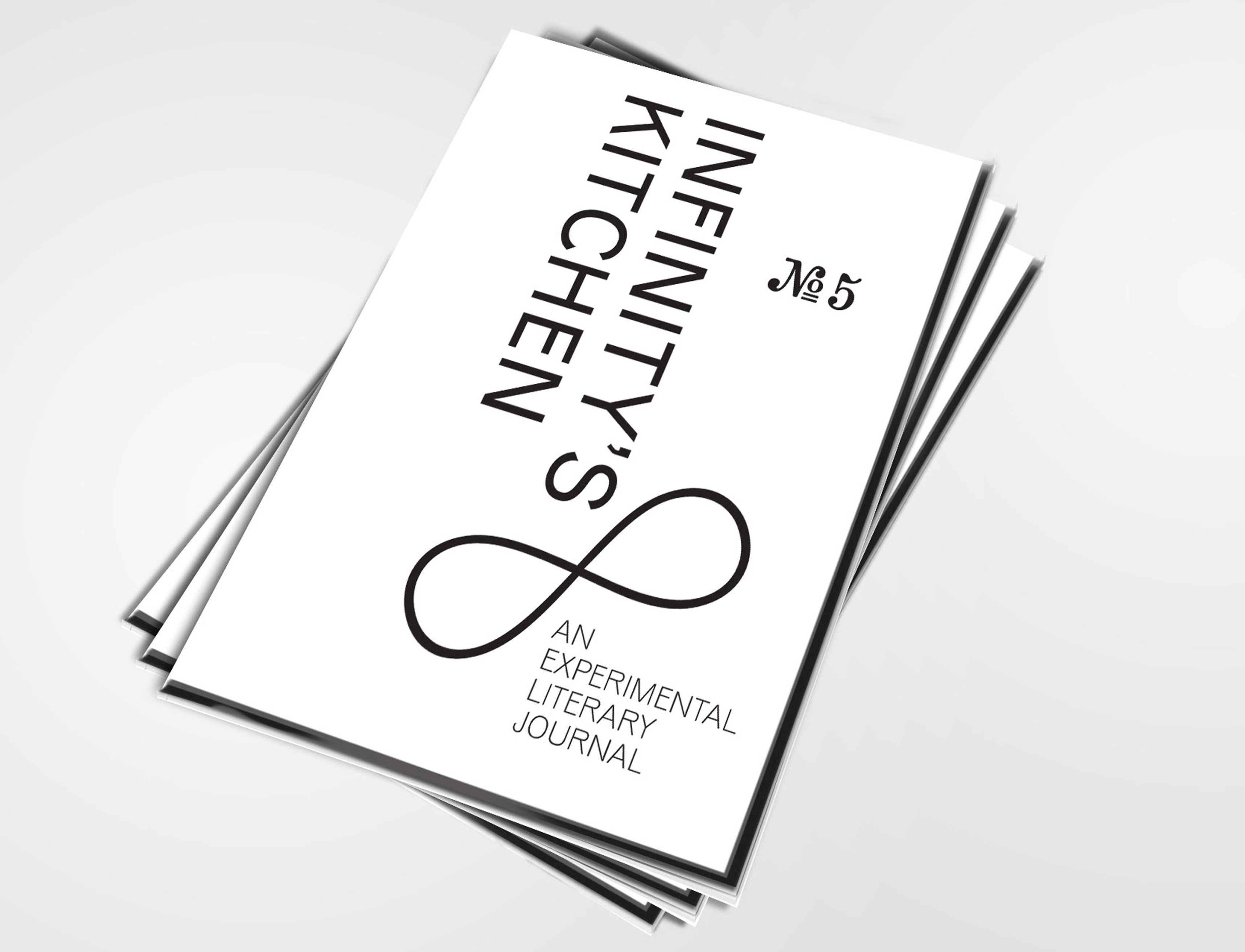
Weighing in at more than 100 pages, this is the largest edition of Infinity's Kitchen ever. It includes constrained writing, antonymic poetry, a hypertext cento poem, visual poetry, algorithmically generated poetry, socially generated poetry, literary criticism, prose in russian doll form and even an apocalyptic press release, all from 15 international contributors.
| Online Features | |
|---|---|
| Anno Domino | Joel Allegretti |
| Nobody Has Liked This Comment Yet | Peter Mattei |
| Spooked | Esther Greenleaf Murer |
| Live Poem | Dave Shaw |
| Enter Key | Davis Schneiderman |
| Always | Lavanya Kannathass |
| Don’t Say Nothing | Satnrose |
| Headlines | Lesser Gonzalez Alvarez |
| Heads or Tails? | Barr Bielinski |
| Pennies | Kristin N. Mcwharter |
| All in Time | Sarah Boothroyd |
Infinity's Kitchen № 04
The fourth issue of Infinity's Kitchen is about silence: overlooked wishes and people, forgotten music, fading ink. Writing is the best way to discuss silence. Along the way, as usual, we're trying some different recipes for the way words are written on the page, because it can't be done out loud.
| Online Features | |
|---|---|
| All-Purpose Recipe for Dissertations | Ed Zahniser |
| Killing Time | Jacob Russell |
| In the Shade of the Allan Gardens Greenhouse | Mike Sauve |
| Heads or Tails? | Barr Bielinski |
| Hey | Brian Baumgart |
| Pennies | Kristin N. Mcwharter |
| Cord | Phil Davis |
Infinity's Kitchen № 03

We've included a paper boat inside the printed publication. Assuming that all the folds are in all the right places, you should actually be able to float this boat, at the park or in your bathtub, and I hope you will. I hope you'll first take the opportunity to unfold the boat and read Hao Cheng's delightful story, "Paper Boats". I also hope you'll try to fold the boat yourself, because it's fun!
| Online Features | |
|---|---|
| My Damascus | Norman Ball |
| DADA, DADA, Won't You Please Come Home: Tropism in the Writing of Poetry | Satnrose |
| Tiny Sparrow Feet | Michael Johnson |
| Do You Know | Dina Kelberman |
| The League of Just on Ice | Dalibor Baric |
| Visual Poetry | Maximus |
| The Boss | Jim Meirose |
| Tinsley’s Pier Portal (contrapuntal no. 2) | Scot Ehrhardt |
| Spiral | Kyle Hemmings |
| Jazz Criticism Reconsidered | Terry Kattleman |
| Essential Moments: Herstories and Loss |
Infinity's Kitchen № 02
With the second issue of Infinity's Kitchen, we're experimenting with ideas that we borrowed from concrete poetry. Concrete poetry, or visual poetry, is written so that the arrangement of the words on the page is important. It's a great way to add some flavor to the poetry.
| Online Features | |
|---|---|
| Zombies | Cameron Scorza |
| Building Blocks | Phil Davis |
Infinity's Kitchen № 01
The first issue of Infinity's Kitchen considers that sometimes, there's nothing to understand. For example: the story with no moral; the image with no picture, or even the picture that's merely a picture; just plain music. Understanding isn't everything. Art is not science.
| Online Features |
|---|